
What the Flock are these cameras around town?
Hey Locals,
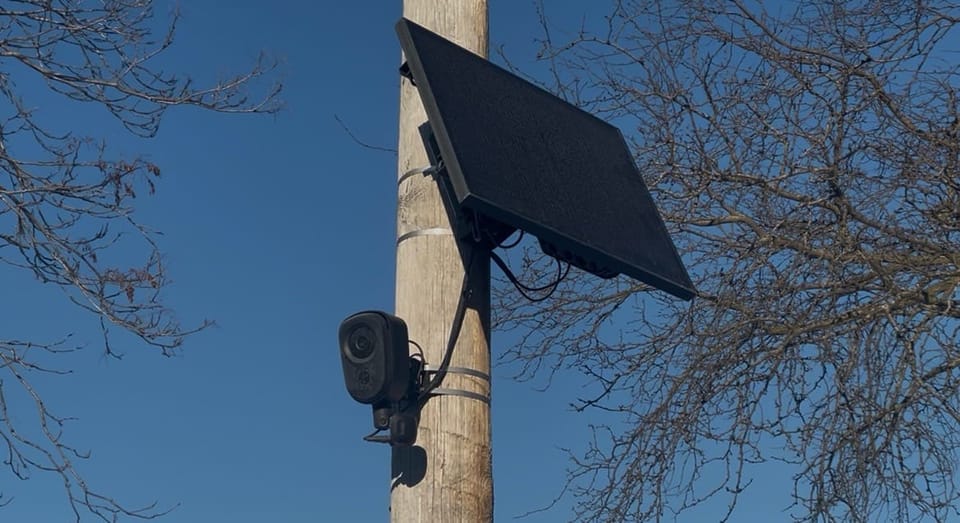
Since last fall, several readers have emailed us about cameras they’ve spotted around town, wanting to know more about their purpose and who uses them. Some have identified them as AI-powered Flock Safety license plate recognition (LPR) cameras and shared security concerns. Others have been concerned about whether they might be used by ICE to target immigrants, considering what’s happening in Minneapolis. (The ACLU says: Flock's system is creating "dangerous nationwide mass-surveillance infrastructure" and "is being used by ICE to help carry out the Trump Administration’s abusive removal program.") We’ve also heard the topic brought up by citizens during public comment sessions at City Council and at last week’s ICE Forum.
For a quick reminder:
- Flock Safety is a fast-emerging, venture-capital-funded startup in the national surveillance technology space. It's valued at $7.5B and has contracts with more than 5,000 communities, 4,500 law enforcement agencies, and 1,000 businesses nationwide, including the Fort Wayne Police Department (FWPD).
- One of its primary products are LPR cameras. These are used by police departments, corporations and other entities, like housing associations, in most (49) states across the U.S. often to assist law enforcement. They can be fixed to stationary locations, like poles, or on vehicles.
- Data gathered by this national network of 80,000+ cameras is entered into a single database. This allows law enforcement, including federal agencies, to search for plates traveling anywhere in the country, often without have to get a warrant.
So...
- How many Flock cameras are in Fort Wayne?
- How are they being used and funded?
- And what benefits and risks should residents know about?
To answer these questions:
- We reached out to: the FWPD’s PIO Sgt. Jonathan Cutler (via FOIA request), the City of Fort Wayne, two City Council members as well as organizations that support immigrants and a few immigrants themselves.
- We also consulted several sources online to analyze Flock’s benefits/risks.
Here’s a quick summary of what we learned.
How many Flock cameras are in Fort Wayne?
- If you’re talking specifically about Flock cameras used by the FWPD, there are 36. Cutler says the FWPD demoed its Flock system in June 2024 and currently leases around 36 Flock Public Safety Cameras, which are active in the city. “All cameras are located on public roadways spread out through the city.”
- But there are about twice as many total LPRs in Fort Wayne (beyond the FWPD’s Flock cams). A national activist group, DeFlock, crowdsourced a map of more than 29,000 LPRs – about two-thirds of which are Flock’s. A quick search for Fort Wayne shows about 71 within/near city limits, mostly concentrated around interstate interchanges.
- It’s unclear who owns and operates the remaining 35 or so LPRs around Fort Wayne. It could be Flock or another company (like their competitor Axon). In addition to law enforcement partners, Flock has corporate customers, like FedEx and Lowes, as well as malls, housing and homeowner associations, small businesses, schools and organizations. “All these customers can choose to grant the police access to their camera feeds, further expanding the surveillance coverage Flock can offer law enforcement,” Forbes reports.
How are the cameras being used and funded?
To understand how Flock’s LPRs are used in Fort Wayne, it helps to understand how they work.
- Currently, Flock cameras focus on taking still images of vehicles. They use "vehicle fingerprinting" to identify make, model, color, and license plates. They also identify features, like dents or bumper stickers, turning these into searchable data points. Again, these are added to a single national database of more than 80,000 Flock cameras any member law enforcement agency can access and search.
- Flock does not currently capture or search for human faces, race, or gender. Still, studies have indicated disproportionate placement in marginalized communities. (A study in Oak Park, IL, found 84% of drivers stopped by police because of Flock were Black.) Law enforcement in some states have also used LPRs to track individuals in immigration or abortion-related cases (supposedly via vehicles).
- Flock is also vastly expanding its capabilities and ambitions. The $7.5B business told Forbes in September it’s expanding into various technologies, like made-in-America drone software to challenge Chinese drone giant DJI’s dominance. Its goal is to “eradicate almost all crime in the U.S.” and “improve traffic management and expedite street repairs.”
Now, let’s talk about information specific to Fort Wayne.
- Cost: The FWPD’s 36 Flock cameras were leased with a contract in 2024 that cost $25,200 the first year with a recurring annual fee of $24,000, as well as a recurring annual fee of $92,995 for Flock’s safety platform and professional services. Cutler says this was primarily funded by a Justice Assistance Grant, as well as the FWPD’s budget, which is taxpayer-funded.
- Use: Cutler says FWPD’s Flock cameras are used to capture pictures of cars and their license plates. “The system stores the images for 180 days, which is consistent with our body camera policy. The system documents approximately 120,000 unique vehicles per day.”
- Results: So far, FWPD reports that Flock has aided them in closing 95 cases, ranging from thefts and rapes to homicides, Cutler says. It’s also helped them recover 25 stolen vehicles and $350,010 worth of property.
- Hotlists: As part of crime tracking, law enforcement agencies can use Flock’s national network to create or access hotlists (vehicles suspected of being involved in crimes). Cutler says: “Fort Wayne receives alerts from the FBI National Hot List, IDACS Hotlist, NCIC Hotlist, and The National Center For Missing and Exploited Children Hotlist. Additionally, officers working active investigations can generate their own hotlist within the narrow confines of that investigation. Searches not tied to an investigation are not allowed. We receive around 1.5 million alerts from hotlists each month.”
Along with these benefits, what risks should residents know about?
- Data security: Since launching in 2017, Flock has gotten flack for security vulnerabilities and questionable business practices. The FWPD provided us with a factsheet from Flock (here) addressing security concerns. It notes that Flock has publicly disclosed and addressed its security vulnerabilities as they’ve come up. While it’s difficult to verify exactly how secure the system is, the company’s evolution portrays it as a fast-moving tech-startup that’s learning and adapting as it grows.
- State regulation: Along with the systems themselves, there’s also the use of those systems by local and federal groups. Flock claims they do not sell or monetize data, but they allow local law enforcement to share data with other agencies across state lines, including federal agencies. This has created issues when states have different laws. For instance, Forbes reports that the state of Illinois is “investigating whether cops broke the law there when they gave out-of-state agencies access to their Flock feeds to hunt down breaches of immigration or abortion law.” (Flock has since updated its systems to prevent out-of-state sharing where it’s prohibited.)
- Immigration enforcement: Federal agencies, like ICE, can sometimes gain access to Flock’s systems (and often without a warrant). Tech news outlet 404Media obtained records of nationwide searches, which include a field where officers list the purpose of their search. The ACLU reports: “These records revealed that many of the searches were carried out by local officers on behalf of ICE for immigration purposes, including its notorious Enforcement and Removal Operations division. Emails from police departments in Oregon also shed light on how local police are providing informal assistance to ICE.”
- Personal privacy: Beyond hotlists (vehicles suspected of crime), Flock and other LPRs can capture and store data about average citizens (not suspected of crime). This type of surveillance/recordkeeping is technically prohibited by the federal Privacy Act (Fourth Amendment), yet a vast data broker industry exists, and LPRs may expand capabilities for law enforcement or other agencies to “run around privacy laws and the Constitution,” the ACLU says (as in, access personal information without a warrant).
- Crime reduction: Many law enforcement groups, including FWPD and the nearby Wells County Sheriff’s Department have reported positive impacts from using Flock. In fact, Councilman Geoff Paddock (D-5) tells us: “This is one reason our homicide solve rate is nearly 100%, so these cameras have helped our local law enforcement.” Nationally, the results are mixed, with critics, like DeFlock, pointing out that Flock has self-published studies promoting its work and a study of ALPRs (automated LPRs) in Piedmont, CA, found that less than 0.3% of ALPR hits might translate into a useful investigative lead, yet police still logged information on people's movements throughout the day, leaving some to question whether the cameras are worth the risks.
So do Flock cameras in Fort Wayne put local immigrants at risk?
Cutler and others reiterated that the Fort Wayne Police Department will not assist ICE agents if they come to our city, and this appears to extend to Flock cameras. Cutler says: “ICE is not an agency that we share scans with. A network audit performed (on 2/11/26) does not show any searches for immigration related investigations.”
We also reached out to local immigrants and organizations that serve them, including Fuerza Unida, El Mexicano News, Language Services Network, Amani and Catholic Charities. Everyone who responded said they were unaware of the cameras or didn’t know enough about them to comment.
Our two cents: In the age of fast-evolving AI and billion-dollar businesses pushing boundaries to profit from it, we’ve seen a lot of tech-related developments lately (like data centers) that are rapidly expanding to cities and building out vast national networks before their technologies are fully understood by average residents – and perhaps even by their own creators. This Silicon-Valley-esque “move-fast-and-break-things” mentality threatens to compromise the purposefully slow processes that democratic governments use to assess risks and hold companies accountable. This may require some technological backpedaling down the road as we learn more. It’s above our pay grade to determine whether Fort Wayne should have these (or any) cameras, but at the very least, we believe citizens should be notified it’s happening. The City confirms it was aware of the FWPD’s contract with Flock, yet Cutler says there was no public announcement when the cameras were installed in June 2024. This may have contributed to concerns and suspicions as residents have stumbled upon cameras near their neighborhoods without explanation. Other cities, like Kettering, Ohio, have published explainers of their Flock programs for residents. It would be great to see more public information about Fort Wayne’s LPRs, especially as groups, like immigrants, are asked to bear the risk of their presence.
Thanks for reading, Locals!
Your Editor,
Kara Hackett, with reporting assistance from Contributor Jeff Blossom