
What to know about FWCS School Board candidates + issues
Hey Locals,
Early voting for the November midterm election has begun, and after our coverage of the Allen County Superior Court judicial race last week, a reader asked if we’d look into the Fort Wayne Community Schools (FWCS) School Board (aka Board of School Trustees) race.* They said they haven’t been able to find much information about the candidates.
For a quick overview:
- Voters within the FWCS district can cast a ballot for two at-large seats on the seven-person school board.
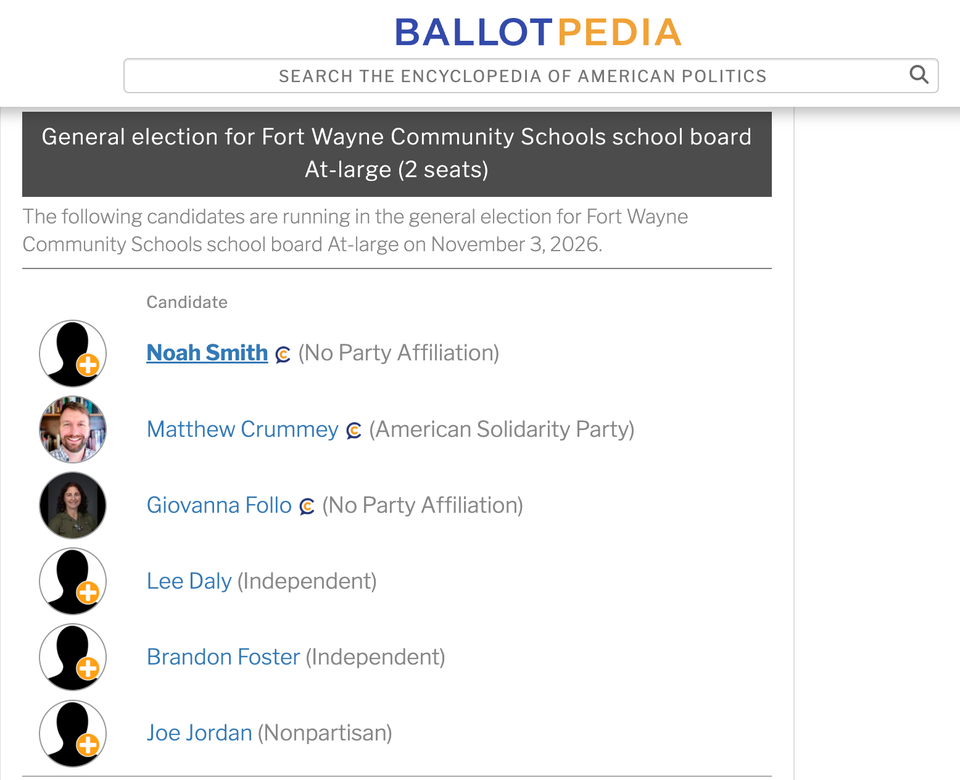
- Five candidates are running for the two at-large seats, including: Matthew J. Crummey, Lee John Daly, Giovanna Follo, Joe Jordan, and incumbent Noah Smith.
- Brandon Foster, who made headlines earlier this year after being fired by FWCS, has dropped out of the race, according to a recent post on Facebook. The former Irwin STEM Magnet School principal says he was fired because he “asked about raising the achievement of Black students across the district,” 21Alive reports.
A correction from Tuesday:
- The FWCS School Board race is no longer nonpartisan, as of the new state law SEA 287 in 2025.
- However, none of the FWCS at-large candidates have declared an affiliation with either the Republican or Democratic party. This means: If you vote straight ticket, you still need to select candidates.
- It turns out: School board candidates remaining nonpartisan is a statewide trend. A recent letter from the publisher of the Indiana Citizen notes that more than half of school board candidates this fall have opted against identifying with a political party despite the new law. It also notes that lawmakers didn’t require school board candidates to provide basic information, like email addresses, when they filed for office, which complicates the process of getting information about them – beyond their declared party.
All to say: If you feel like you don’t know much about your school board candidates in Indiana, you’re not alone!
So…. what does the FWCS School Board do? Who’s running for the two at-large seats? And what key issues are the candidates discussing?
To compile this report, we gathered information from several events and sources, including:
- A recent school board candidate forum sponsored by the Indiana Coalition for Public Education Northeast. (Watch the full event here.)
- Local education reporting, including The JG’s* Election Guide.
- Anne Duff, League of Women Voters Fort Wayne education team chair and former FWCS board member.
- Brandon Foster, former Principal at Irwin STEM Magnet School and former school board candidate.
Let’s dive in.
- What does the FWCS School Board do?
The FWCS School Board, also known as the Board of Trustees, abides by several bylaws available here.
Here are a few quick things to know:
- The board is composed of seven elected members. Five represent specific districts (each corresponding to an FWCS High School), and two are at-large members. Currently, the board is led by President Noah Smith, who’s at-large and up for re-election this year.
- The board is responsible for hiring and supervising the District Superintendent. This is the only administrator they oversee, Duff says.
- They also write policy and approve budgets and major purchases. While the board sets goals, the administration is tasked with implementing them.
- In theory, board members could have very limited roles; however, many prefer to be more involved. They often attend school events, observe classrooms, and even judge student projects, Duff says.
- There are also a lot of education-related decisions that board members do not have control over. This includes controversial topics, like the state’s voucher program and recent legislation related to transgender students.
- Who is running for the two at-large seats?
- Matthew J. Crummey (American Solidarity Party), an engineer and first-time candidate. Crummey did not attend the panel, but provided answers to The JG.* He says his campaign’s focus is parental involvement, increasing human interaction and decreasing technology dependency, and instilling classical values in public education.
- Lee John Daly (Independent), a retired teacher and first-time candidate. Daly spent 30 years teaching in both East Allen and FWCS districts before retiring in May.
- Giovanna Follo (No party), an Associate Professor of Sociology at Wright State University. Follo has experience teaching dual-credit students and has also worked as a social worker. She credits her research background as an academic in helping to prepare her for the rigors of the school board.
- Joe Jordan (No party), President and CEO of the Boys & Girls Clubs of Northeast Indiana. Jordan sits on numerous community boards, including Fort Wayne United. He is also a member of the Allen County Judicial Nominating Commission. Jordan made headlines earlier this year when the Club announced its intention to sell Lutheran Park. He did not attend the panel, but also provided answers to The JG*.
- Noah Smith (No party), the incumbent and current school board president. Smith has served on the board since 2021, and he drew controversy earlier this year when he resigned from his District 3 seat and was immediately sworn into the at-large seat vacated by Anne Duff.
- What key issues are the candidates discussing?
Here are three issues that were top of mind for candidates at the panel:
- Budget concerns.
Decreases in school funding due to Gov. Mike Braun’s property tax legislation, SEA1, have already hit FWCS hard. In March, district representatives told WANE 15 they would have to cut $12.5M from the budget during the next three years. As current board president, Smith also warned panel attendees of current proposed legislation at the state level that would eliminate property taxes in favor of increasing LIT (Local Income Taxes). This could also affect school funding.
While state budget decisions are out of board members’ control, here are a few topics they discussed related to the matter:
- Smith and Crummey emphasized maintaining autonomy for FWCS. At the panel, Smith discussed the state’s trend of taking over “failing” school districts, like in Indianapolis, Gary, and Muncie. He warned that Fort Wayne could be next, and said FWCS wants to “maintain independence.” Crummey also told The JG he wanted to “push for more local autonomy in improving our community schools.”
- Daly criticized high administrative pay within FWCS. The retired teacher noted that out of 6,000 staff, only 149 earn over $100,000 per year. He said the technology department was gutted during previous cuts, and he wondered about administrative bloat: “Do we need three assistant superintendents? I don’t think so.” He also told The JG* he would advocate at the state level against the voucher program, which he characterized as “grossly mismanaged.”
- Smith supported keeping cuts away from the classroom. But unlike Daly, he argued that administrators, like principals, should earn more than $100,000 because of the demands of their jobs.
- Follo asked the district to consider what can be done that doesn’t cost money. She suggested increasing volunteerism within FWCS, saying there are “a lot of people in the community who are willing and wanting to come into schools and help.” Other members of the panel also noted that community and business partnerships between FWCS and Fort Wayne have grown exponentially in the last four years. (One example is AmpLab at Electric Works.)
- Enrollment challenges.
Overall, candidates who attended the panel and were interviewed by The JG raised concerns about the state’s voucher program, saying it takes funding from public schools and decreases FWCS enrollment. (In fact, nearly 30 minutes of the panel was spent discussing vouchers, even though it’s also not something board members can control, since it is decided at the state level.)
Here are a few ways the candidates suggested addressing enrollment concerns:
- Crummey said FWCS needs to “compete for students.” He recommended opening the system to “part-time students, to alternative education models and to value-based educational initiatives,” adding that: “Parents want to have confidence that their values will not be overridden with extreme views and hidden agendas.”
- Daly voiced the challenge of FWCS competing with private and parochial school options. “We need to show that our students far outweigh the private sector and parochial sector in achievement in all subject matters,” he said. “We also need to show that our graduates far outweigh the others in landing great jobs and career opportunities after graduation.”
- Follo spoke about ensuring balance between students’ career preparation and exploration of different paths, so students aren’t locked into a particular career choice too early. An FWCS parent herself, she believes “the district remains attractive to families and their students by providing teachers with a supportive work environment, which in turn, provides students with an engaged learning experience.”
- Jordan said the best way to retain the student body is “to give families compelling reasons to choose – and stay in – our schools.” He supports a “district-wide focus on academic excellence, student safety, strong extracurricular opportunities, career readiness, and meaningful family engagement.”
- Managing relationships on the FWCS board and with its schools, parents, and broader community.
Current board member and District 1 candidate, Julie Hollingsworth, noted that board members can’t act unilaterally, which makes collaborating and working well together key. Getting community input on decisions will also be a priority for the incoming board, as FWCS embarks on its strategic planning process during the next few years. The district also recently announced a listening tour* related to $17M in potential funding from Indiana Lifelong Learning Projects.
As for managing relationships:
- Daly said it’s important for board members to visit with teachers, administrators, and parents. He wants to spend time in schools, observing what’s happening in classrooms. He reminds the community that even if you don’t have kids in the FWCS system, you’ll still encounter FWCS graduates out in the world. Overall, Daly said FWCS board members “need to be in schools” regularly to see what the climate of the schools is like, from the top schools to the lowest performing ones. “Board members need to be aware of the climate of every school.”
- Follo said she’s already begun the process of community engagement by going to area partnerships, community meetings, and connecting with parents and students to better understand challenges facing FWCS. She also worked with parents to get the opt-out for the 3DE program passed, and she wants (if possible) to be able to join bus rides to better understand what bus drivers experience. (The district’s bus driver shortage has been well-documented.)
- Smith highlighted the upcoming listening tour, which will be conducted with “no preconceived agenda.”
A few other topics discussed during the panel included:
- The role of arts and humanities courses in an era when STEM often gets the most emphasis.
- One audience member also said she was “displeased” with the FWCS approach to schools in Southeast Fort Wayne. She felt the district wasn’t providing students in the area with enough opportunities, saying: “Children are waiting for us to take the responsibility.”
To that point: A few areas that didn’t get much discussion during the panel were how the board plans to address underperforming schools, and what its strategies are for attracting, hiring, and retaining high-quality teachers and administrators — especially in underserved communities.
While Foster officially dropped out of the race this week, he spoke on the panel and made several comments related to the achievement gap between Black students and statewide standards. He said he received pushback from FWCS after inquiring about the state of Black students’ test scores – questions he claims led to his termination.
He tells us he wants to “sound the alarm for the educational neglect that is happening to our Black students” and continue asking hard questions about academic standards and FWCS HR practices, which he feels disadvantage people from marginalized communities.
These concerns merit further discussion, and we hope to report more in coming weeks.
In the meantime, keep us posted with other questions you have about the upcoming election.
Until next time, Locals!
Your Reporter and Editor,
Rachel Horton and Kara Hackett